Together with Birgit Schweiger, Renate Billensteiner
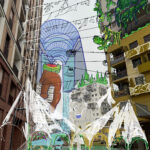
Following the ‘Art for Radical Ecologies Manifesto’[1], art and artistic practices can not only spell out collective imaginaries that may shape collective futures but can also directly impact our forms of coexistence. In open-ended, enacted environments, artistic perspectives can radically re-imagine human and other-than-human lifeworlds to shape trans-species ecologies towards sustainable and non-extractivist ways of living. Urban spaces have traditionally served as foci of political, economic, and cultural activities, spawning collective visions of human coexistence that influence communities worldwide through continuous processes of ‘planetary urbanization’[2]. Oftentimes, they are places where collective futures are negotiated, imagined, and translated into physical environments. Re-imagining lived urbanity, we use drawing as an artistic strategy to sketch out urban utopias that counteract current crises, experimenting with collective visions of urban ecologies that enable trans-species cohabitation, the disintegration of barriers of class, race, gender, and religion, and the collective enactment of sustainable urban environments for all city dwellers. ‘Making kin’[3] with other lifeforms, we radically re-invent the spaces we inhabit and re-construct urban centers as places of encounter, radical imagination, and collective (counter-)action. Dissolving the boundaries between subject and object, we transform the world collaboratively through graphic intra-action.[4]
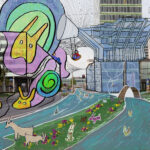
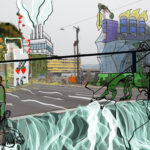
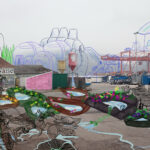
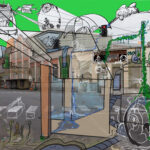
We, therefore, use collaborative drawing as an artistic strategy to re-imagine urban lifeworlds by drawing over photographs of two cities in Austria – Linz and Vienna – which are not only our places of residence, but also incorporate different forms of lived urbanity. Vienna with its rich history and densely built historical center incorporates the charm of old Europe but provides ample ground for radical re-imagination. Linz is a smaller town, marked by industrial production, radical urban transformation, and the integration of the urban center with surrounding suburban and rural spaces. During the project, we take turns transforming photographs of city views in drawing, sending the altered photos back and forth, accompanied by comments and annotations that expand on the ongoing drawing process. This way, the drawings trace conceptual approaches, imaginaries, thoughts, and inspirations expressed in graphic language, which contextualize newfound urban utopias. Multiple layers of sensing and sensemaking can be added to the drawings that are later used for examining results. Our collective drawing approach can be understood as a tentacular thinking process, linking multiple perspectives in a sympoietic vision of collective futures. The re-imagination of urban futures becomes a collective act of communication in graphic form that can potentially be opened to other artists/scholars. In this sense, collaborative drawing, understood as a visual dialogue, is used to express and to visualize radical urban ecologies that can inspire political action, social change, and cultural revolution.

[1] https://instituteofradicalimagination.org/2023/11/02/art-for-radical-ecologies-manifesto/
[2] Brenner, Neil and Schmid, Christian (2013) Planetary Urbanization. In: Brenner, Neil (Ed.) Implosions/Explosions. Towards a Study of Planetary Urbanization. Berlin/Boston: JOVIS, pp 160-163.
[3] Haraway, Donna (2016) Staying with the Trouble. Making Kin in the Chthulucene. Durham: Duke University Press.
[4] Barad, Karen (2007) Meeting the Universe Halfway. Durham: Duke University Press.